

CA 125 Ovarian Cancer Range: Normal, High and What They Mean

Dr. Vrundali Kannoth|5 min read|
In most families, health is tracked in small but steady rituals: a mother checking on her kids, tracking blood pressure, or simply reminding your father about his evening BP pills. But when it comes to women’s health, especially the ovaries, the signs often go unnoticed. They’re subtle, sometimes hidden. That’s where knowing about CA 125 matters.
Understanding CA 125 ovarian cancer marker test gives power to make preventive choices, to ask the right questions, and to get timely treatment if needed. Think of this as your friendly guide to CA 125: what it means, when to worry, and how to understand the numbers on your report. Let’s make it simple, clear, and useful for you and your loved ones.
What is the CA 125 ovarian cancer marker?
CA 125, or Cancer Antigen 125, is a protein-sugar complex (glycoprotein) found on the cell surface of ovaries, fallopian tubes, peritoneum, pleura, colon, kidney, and stomach. Normally, its levels stay low. But under certain conditions, they can rise. Doctors often use the CA 125 ovarian cancer test to keep track of the treatment or spot early warning signs in women at risk. But here’s the catch: this test alone cannot confirm cancer. Why? Because ovarian cancer marker CA 125 levels can go up for many harmless reasons, like periods, pregnancy, or conditions such as fibroids, endometriosis, or infections.
That said, other cancers like those of the uterus, cervix, pancreas, liver, breast, or colon can also cause a rise; ovarian cancer is the most common reason. CA 125 is a useful marker, but it must always be read alongside other tests and scans.
Why is it used for a CA 125 ovarian cancer treatment?
Doctors find CA 125 important because it tends to go up in many ovarian cancer cases. Research shows that CA 125 levels are elevated in 80-90% of advanced-stage ovarian cancers and 50% of early-stage cases.
The test is usually suggested for three main reasons:
- •To check if treatment is working or if cancer has come backThe CA 125 ovarian cancer marker test is usually used in women already diagnosed with the disease. It checks if the treatment is helping or if the cancer has returned.
- •To learn about a pelvic lump or growthIf an ultrasound or CT scan shows a lump in the pelvic area, doctors may check CA 125 ovarian cancer range along with other tests.
- •To screen women at high riskIf you have a strong family history of ovarian cancer, your doctor may suggest CA 125 ovarian cancer screening to check for early signs of the disease.
CA 125 marker vs. other tumour markers
Certain CA 125 tumor marker for ovarian cancer are used as part of cancer detection, but no single test is a sure-shot diagnosis. Doctors combine them with imaging and other evaluations for accuracy.
| Marker | Use | Drawbacks |
|---|---|---|
| CA 125 ovarian cancer marker | Monitors ovarian cancer, and also uterus, cervix, pancreas, liver, breast, colon | Can be high due to other non-cancerous reasons |
| AFP (Alpha-fetoprotein) | Detects liver cancer and germ cell tumours | Increases in hepatitis, cirrhosis, and pregnancy |
| CEA (Carcinoembryonic Antigen) | Records treatment, progress and recurrence in colon, rectum, pancreas, breast, lung, and thyroid cancers | Can rise due to smoking or other non-cancerous reasons like ulcers |
| CA 15-3/CA 27-29 | Monitors breast cancer treatment and progress | Can increase due to liver disease or pregnancy |
| CA 19-9 | Checks pancreatic cancer | Can rise due to pancreatitis, gallstones or liver malfunction |
Read more about other ovarian cancer tumour markers and how they work together
What is the normal CA 125 ovarian cancer range?
The normal CA 125 level is less than 35 units per milliliter (U/mL) of blood. This means that if your test result shows a value below 35, it’s usually considered within the safe ovarian cancer marker range.
Interpreting CA 125 test results
Getting your CA 125 ovarian cancer prognosis can feel stressful, but don’t forget: a high number doesn’t always mean cancer. Here’s how you interpret the results:
- •NormalBelow 35U/mL
- •Mildly advanced35-65 U/mL - likely related to non-cancerous causes like menstruation, pregnancy, and infection.
- •Moderately-highly advancedabove 65 U/mL - increases suspicion for ovarian or other cancers, but is always subject to follow-up imaging or biopsy.
When is it considered high?
Anything over 35 U/mL is considered elevated. What matters is how the number moves. A rise may need attention, and a decrease means progress.
What causes elevated CA 125 levels?
When CA 125 goes up, it means that the body is reacting to something. Sometimes it’s harmless, other times it calls for checks. Here’s an easy breakdown of what might cause it:
Cancerous vs non-cancerous reasons
| Cancerous causes | Non-cancerous causes |
|---|---|
| Ovarian cancer | Menstruation |
| Uterus, cervix, fallopian tube cancer | Pregnancy |
| Pancreatic cancer | Endometriosis |
| Breast cancer | Uterine fibroids |
| Colon cancer | Pelvic inflammation |
| Liver cancer | Liver diseases |
| Lung cancer | Peritonitis |
CA 125 elevation in endometriosis and menstruation
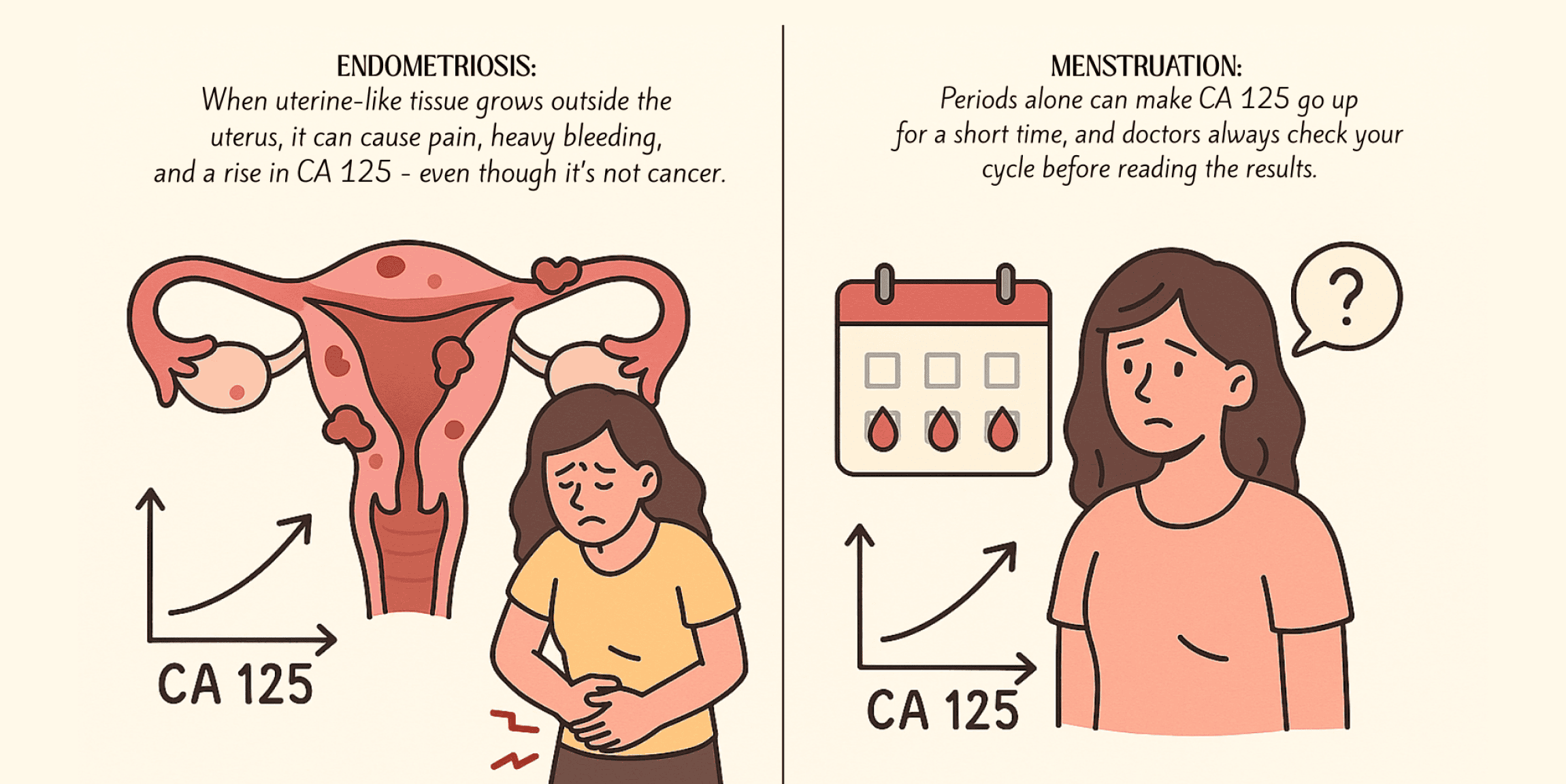
CA 125 isn’t only linked to ovarian cancer. Conditions like endometriosis and even natural changes during menstruation can cause a temporary rise. So if the levels shift a bit, it doesn’t always mean trouble.
Refer to the image below to check how these two can cause a rise in CA 125 levels:
Can you have ovarian cancer with normal CA 125 levels?
Yes, it is possible to get a normal ovarian cancer marker range in your results. A normal report does not rule out the possibility of cancer. That’s why doctors rely on several other tools, like CT scans, MRI, and pelvic exams to get a clear picture.
When should you get a CA 125 ovarian cancer marker test?
It is not a test that needs to be done regularly, but it becomes important when someone is at high risk or has unusual symptoms. Get yourself an appointment with the oncology doctors:
- If you have a family history of ovarian or breast cancer
- During ovarian cancer treatment (for monitoring)
- If you notice unusual pelvic concerns (persistent bloating, pelvic pain, or changes in period)
- High-risk patients like women with BRCA gene mutations or hereditary risks

If these symptoms feel familiar, read what ovarian cancer is, why it happens, and how doctors approach it.
Limitations of CA 125 ovarian cancer marker test
While CA 125 ovarian cancer range is effective in detecting cancer, it is not perfect. Here’s what you should know:
- •It is not specific to ovarian cancer,fluctuations happen due to other non-cancerous reasons as well.
- •Some ovarian cancer patients had low CA 125 ovarian cancer symptoms,which makes the test subjective.
- •It can sometimes indicate presence of other cancers-like uterus, cervix, pancreas, liver, breast, and colon.
- •CA 125 ovarian cancer rangeis not a determining factor it is always seen with other tests and examinations.
Don’t delay CA 125 ovarian cancer symptoms: Early action saves lives
Always remember that a single high or normal result is not a verdict. Tests like imaging, CA 125 tumor marker for ovarian cancer, and physical exams complete the picture. Understanding CA 125 empowers better questions, timely action, and thoughtful care.
If your results feel confusing, Everhope’s oncology doctors can help you make sense of them.
As a little takeaway, keep a simple health diary noting cycles and symptoms. A little precaution goes a long way.
Questions
FAQs on what is CA 125 ovarian cancer
Can your predict CA 125 ovarian cancer prognosis?
Yes, it can be helpful when mixed with other tests. Doctors track the ovarian cancer marker CA 125 levels over time to get an idea.
What symptoms may prompt a CA 125 test?
Common symptoms include bloating, pelvic pain, abdominal swelling, or feeling full quickly after eating.
Who should I talk to if my ovarian cancer marker CA 125 levels come back high?
Start with your gynecologist or an oncologist. They can look at the bigger picture and guide you on the next steps.
If my CA 125 is high, what other tests will the doctor suggest?
Usually imaging tests like ultrasound or CT scans, and sometimes more blood tests, to confirm what’s really going on.
Related Blogs


Diagnosis8 min read
Tumor Profiling for Head and Neck Cancer: Unlocking Precision Treatment
Dr. Vrundali Kannoth