
Insights5 min read
प्रोस्टेट कैंसर के लक्षण (Prostate Cancer Ke Lakshan): कैसे पहचानें
Dr. Vrundali Kannoth
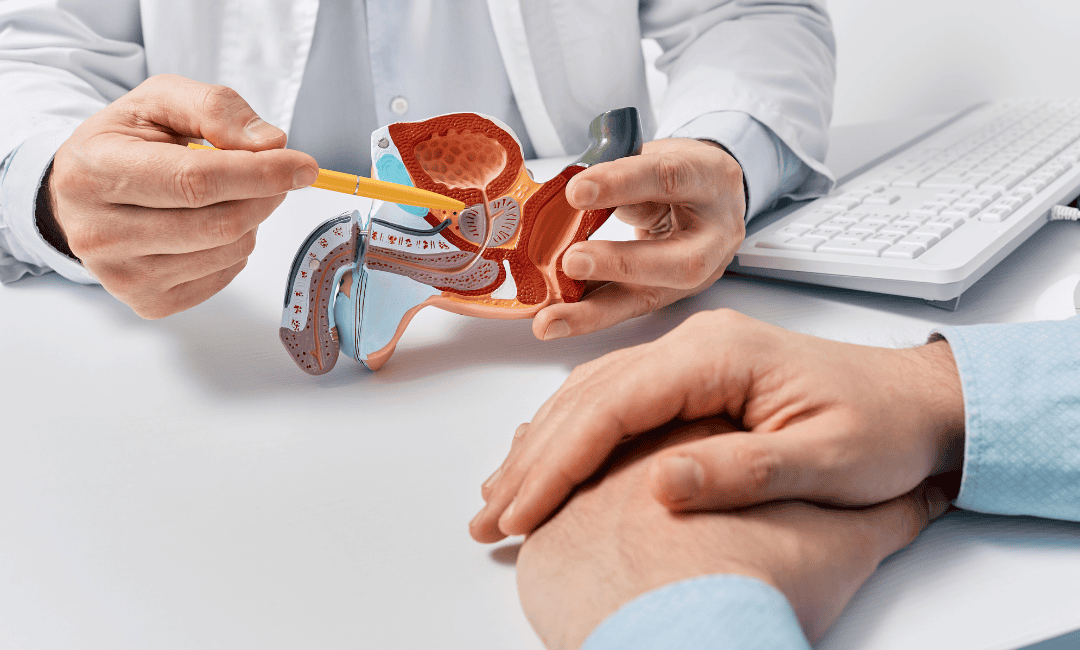
Prostate cancer is an abnormal growth in the prostate gland—a small, walnut-sized gland found below the bladder in men. The gland is an essential part of the male reproductive system by secreting seminal fluid to nourish and carry sperm.
Trouble starting or stopping urination, weak or interrupted urine flow.
See a doctor if you have any of the symptoms above, or if you have risk factors like family history or are over age 50 with urinary changes. Immediate medical attention is needed for severe symptoms such as inability to urinate, fever with urinary pain, or signs of spinal cord compression like leg weakness or loss of bladder control.
Age
The risk increases sharply after age 50; the majority of cases occur in men aged 65 and older.
Family History
Having a close relative (father, brother) with prostate cancer doubles the risk.
Genetics
Mutations in BRCA1, BRCA2, and HOXB13 genes increase susceptibility.
Diet and Lifestyle
Obesity, high-fat diet, and low physical activity are linked to higher risk, though evidence varies.
Hormonal Factors
Testosterone may influence cancer cell growth, though this relationship is complex.
Occupational Exposure
Long-term exposure to chemicals, such as in firefighting or metalworking, might increase risk.
Ethnicity
African-American men have higher risk in Western countries; this pattern is less evident in the Indian population.
Step 1: Initial Symptoms & Check-up
Symptoms: Changes in urine, hematuria, pelvic discomfort. The doctor conducts rectal exam and symptom check
At Everhope Oncology, we see prostate cancer as more than a diagnosis; it’s a unique journey. With expert care, empathy, and the latest treatments, we stand with you at every step, guiding you toward strength, hope, and healing.

No question is too small when it comes to your care
Early-stage prostate cancer often has no symptoms. Later signs can include difficulty urinating, frequent urination, blood in urine or semen, erectile dysfunction, pelvic pain, and fatigue.
Risk factors include age (mostly men over 50), family history, certain gene mutations (BRCA1/2), obesity, diet, and some occupational exposures.
Diagnosis involves PSA blood tests, digital rectal exams, imaging scans, and sometimes biopsies to confirm cancer and assess its aggressiveness.
Many prostate cancers detected early are treatable. Treatment options include surgery, radiation, hormone therapy, and active surveillance.
Common side effects include urinary incontinence, erectile dysfunction, fatigue, bowel problems, and hormonal changes depending on treatment.
Some prostate cancers are linked to inherited gene mutations. Having a close relative with prostate or related cancers increases risk.
Everhope x SSO Hospital, Ghatkopar West
Silver Point, 7th Floor, Lal Bahadur Shastri Marg, Kasturi Park, Ghatkopar West, Mumbai 400086
Mon to Sun, 9am to 9pm
Everhope x SSO Hospital, Andheri West
2nd Floor, New Link Road, above Axis Bank, Andheri West, Mumbai 400053
Mon to Sun, 9am to 9pm
Everhope x SSO Hospital, Thane
Ground Floor, Amber Arcade, below Waviker Eye Institute, Majiwada, Thane 400601
Mon to Sun, 24 hrs
Everhope x SSO Hospital, Chembur
6th Floor, 604 Business Point, DK Sandu Marg, Chembur, Mumbai 400071
Mon to Sun, 9am to 9pm
Everhope x SSO Hospital, Vashi
Clinic 51, 4th Floor, Shanti Center, Sector 17, Vashi, Navi Mumbai 400703
Mon to Sat, 11:30am to 9pm
Everhope x SSO Hospital, Charni Road
9th Floor, Mehta Mahal, 15 Mathew Road, Opera House, Charni Road (East), Mumbai 400004
Mon to Sun, 9am to 9pm
Everhope x SRCC Hospital, Haji Ali
1-1A, Keshavrao Khadye Marg, Haji Ali, Haji Ali Government Colony, Mahalakshmi, Mumbai, Maharashtra 400034
Mon to Sun, 24 hrs
Everhope x EPIC Hospital, Ahmedabad
Rajpath Rangoli Road, behind Rajpath Club, off S.G. Highway, Bodakdev, Ahmedabad 380059
Mon to Sun, 9am to 9pm
Everhope Hospital, Gurugram (Sector 65)
EBD 65, Sector 65, Golf Course Extension Road
Mon to Sat, 8am to 8pm
Everhope Hospital, Gurugram (Sector 14)
Mehrauli-Gurgaon Rd, Anamika Enclave, Sector 14
Mon to Sat, 9am to 6pm
Everhope x SSO Hospital, Belgaum
9666A-2/D, behind BUDA Office, Ashok Nagar, Shivaji Nagar, Belgaum 590016
Mon to Sun, 24 hrs