
Cancer surgery, guided by a robotic system.
A surgeon-controlled robotic system gives a magnified, three-dimensional view and instruments that move beyond the human wrist, so tumours can be removed through small, keyhole incisions and healthy tissue is kept wherever it can be.
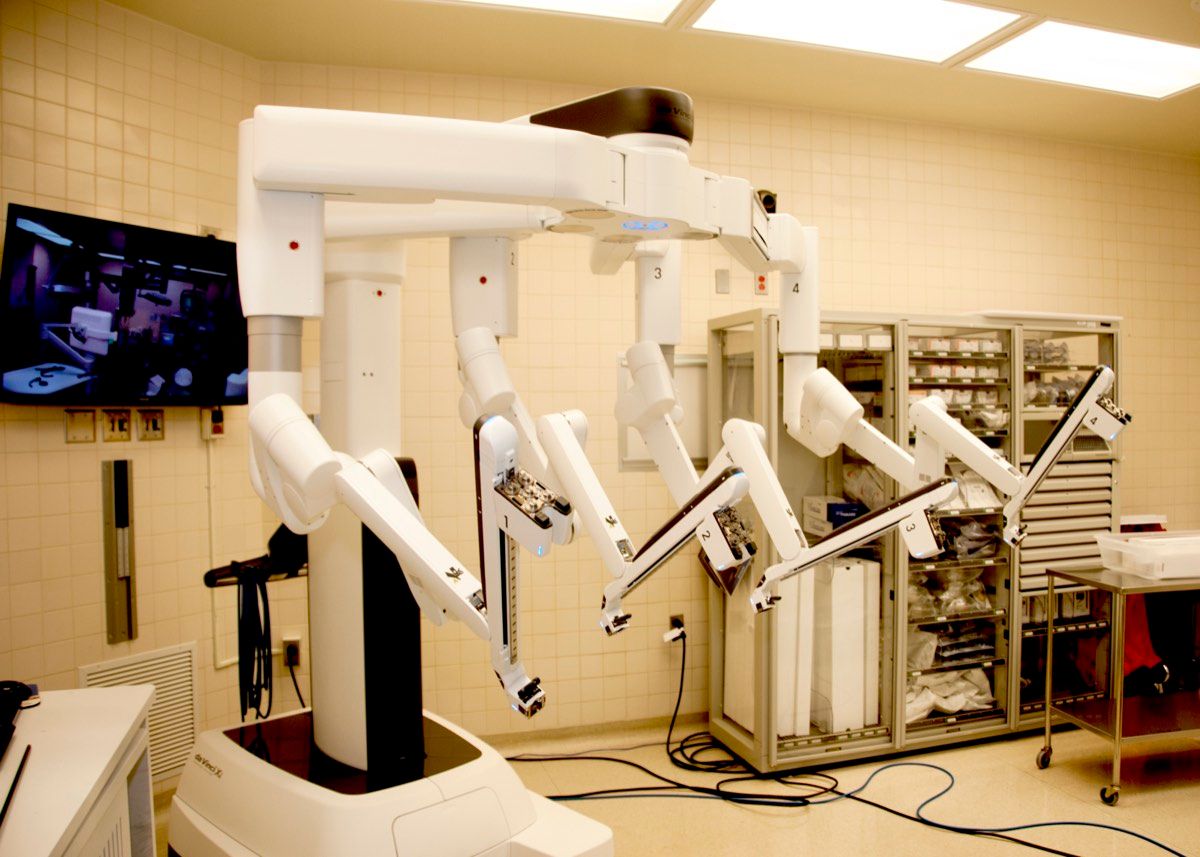
A surgeon in control, with a steadier hand.
In robotic surgery your surgeon performs the whole operation. The system never acts on its own.
Seated at a console in the same operating theatre, your surgeon controls fine instruments that bend further than the human wrist, guided by a magnified three-dimensional view of the operating field. Their hand movements are translated into smaller, steadier movements inside the body, so a tumour can be reached through keyhole incisions rather than one large opening. For cancer surgery this can matter most in tight, delicate spaces such as the throat, the pelvis or around the breast, where fine control protects the healthy tissue nearby.
What actually happens in the operating room.
- Your surgeon sits at the controls
- A few feet from the operating table, your surgeon views a magnified, three-dimensional image of the surgical area — far clearer than a flat screen.
- The instruments move with your surgeon's hands
- Slim, fully articulating instruments mirror your surgeon's hand and finger movements, bending and rotating in ways a human wrist cannot.
- Small incisions, not one large cut
- The instruments enter through incisions just one to two centimetres wide, disturbing far less healthy tissue around the tumour.
- Your surgeon stays in control throughout
- Every movement is your surgeon's own, translated into precise instrument motion in real time. The system does not act on its own at any point.
What the technique is built for.
Why a robotic approach can help in cancer surgery.
A magnified 3D view
The surgeon sees the operating field enlarged and in depth, rather than on a flat two-dimensional screen.
Instruments beyond the wrist
Fully articulating tools reach angles open surgery cannot, which helps in confined spaces such as the head and neck or the pelvis.
Smaller incisions
Keyhole access is intended to mean less blood loss, less pain and smaller scars than open surgery.
A recovery planned to be smoother
Minimally invasive access aims at a shorter hospital stay and a faster return to daily life, when a robotic approach suits your case.
Cancers and procedures a robotic approach can help with.
Whether robotic surgery suits you depends on the cancer, its stage and your overall health. Your surgeon decides this with you, after reading your reports.
Transoral robotic surgery (TORS)
Reaches cancers of the throat, tonsil and voice box through the mouth, with no external cut in the neck.
Robotic neck dissection
Removes affected lymph nodes in the neck through small, hidden incisions rather than one long open one.
Robotic radical hysterectomy
Treats cervical and uterine cancers through keyhole incisions, with a magnified view of the pelvis.
Nipple- and skin-sparing mastectomy
Removes breast tissue while preserving the skin, and the nipple where it is safe to do so, to support reconstruction.
Oncoplastic breast preservation
Combines removing the cancer with plastic-surgery technique, to keep the natural shape of the breast.
How the approaches compare.
- Open surgery
- Reaches the tumour through one larger incision, giving the surgeon direct access. It remains the right choice for many operations.
- Laparoscopic (keyhole)
- Works through small incisions using long, straight instruments, viewed on a flat two-dimensional screen.
- Robotic
- Also keyhole, but adds a magnified 3D view and wristed instruments for finer control in tight spaces. Your surgeon will explain which approach fits your case, and why.
What to expect afterwards.
Recovery varies with the cancer, the procedure and your general health, so your surgeon gives you a timeline for your own case. In general, keyhole incisions are intended to mean less pain and a shorter hospital stay than open surgery, and many people return to light daily activity sooner. Your care team plans your recovery with you before the operation, and stays your point of contact through the weeks that follow.